0DTE Options and Gamma Risk

What the data actually shows: intraday gamma spikes, the open and close amplification windows, and why same-day expirations have structurally changed SPX market behavior

See Live SPX GEX Levels →
What 0DTE Options Actually Are — and Why They Changed Everything

Zero Days to Expiration (0DTE) options are contracts that expire on the same calendar day they are traded. For SPX, that now means every trading day — CBOE introduced daily SPX expirations in May 2022, completing the transition to Monday/Wednesday/Friday that had begun earlier. The result: more 0DTE volume available every single session, not just on traditional expiration Fridays.

The numbers are striking. 0DTE options now regularly account for more than 40% of total daily SPX options volume. On high-activity macro days — Fed announcements, CPI prints, major earnings — 0DTE share can push past 50–60% of the day's total flow. This is not a niche strategy. It is the dominant options activity in the world's largest equity index.

For traders who do not touch options, this matters anyway: the gamma generated by this volume creates structured buying and selling pressure in SPX and ES futures that is visible, measurable, and repeatable.

  • SPX now has 0DTE expirations every trading day (M/W/F plus T/Th via SPXW)
  • 0DTE accounts for 40–60% of daily SPX options volume on active sessions
  • Gamma on 0DTE contracts is highest near ATM and spikes as expiration approaches
  • On a 1% SPX move, hundreds of billions in 0DTE notional must be re-hedged
  • 0DTE flows are not random — they cluster at specific strikes and create structural levels
  • The amplification effect is strongest at market open and in the final 30 minutes of trading
Why 0DTE Gamma Is Structurally Different From Multi-Day Options

Gamma is the rate of change of delta with respect to the underlying price. In Black-Scholes terms, gamma is highest for at-the-money options and decreases for options that are deeply in- or out-of-the-money. Critically, gamma also increases as time to expiration decreases — and at-the-money gamma approaches infinity as expiration nears. This is not a theoretical curiosity. It is the core structural fact that makes 0DTE risk categorically different from weekly or monthly options risk.

The Gamma Spike Mechanism

Consider a 0DTE SPX put struck at 5,700 when SPX is trading at 5,720. Two hours before expiration, that option has very little delta because it is out of the money. But if SPX drops 25 points to 5,695, the option suddenly goes in the money. The dealer who sold that put must now rapidly buy SPX (or ES futures) to hedge the newly acquired negative delta — and the amount of buying needed per additional point of SPX decline is larger than it would be for a 7-day option in an identical scenario. This is 0DTE gamma risk made concrete: small price moves near key strikes can force large, rapid hedge adjustments.

Why the numbers get large:

SPX is roughly a $5,700-point index. A single SPX contract controls 100 shares worth approximately $570,000 in notional. When 0DTE volume runs at $400–600 billion in daily notional — which is typical on active days — even a 1% underlying move forces re-hedging of $4–6 billion in delta-adjusted exposure. That hedging is not spread over days or hours. On 0DTE, it happens in minutes, concentrated near the strikes where the most open interest sits.

Intraday 0DTE Gamma Behavior — When Risk Is Highest

0DTE gamma risk is not uniform throughout the session. Data consistently shows three distinct risk windows where dealer re-hedging from 0DTE flow creates the most amplified price behavior:

9:30–10:15
VERY HIGH
Opening auction sets the initial GEX picture. Large institutional 0DTE orders hit simultaneously — dealer hedging is most reactive here.
10:15–14:30
LOW–MOD
Mid-session: gamma stabilizes as ATM options lose time value more gradually. Moves tend to be more contained near key GEX levels.
14:30–15:00
ELEVATED
Pin risk begins: dealers start adjusting hedges as options approach binary win/lose states ahead of expiration.
15:00–16:00
EXTREME
Final hour: gamma is most explosive near ATM strikes. 0DTE vol spikes are most common here. Positions pinning at key strikes can cause sharp directional moves as they expire or roll.

Illustrative pattern — actual behavior varies with expiration type (M/W/F) and macro context.

What this means in practice:

The opening and closing windows are where 0DTE-driven gamma risk is most visible in price action. During the open, large options orders placed before the bell force dealers into immediate, large hedges — this is why SPX often makes its biggest intraday move in the first 15–30 minutes. During the close, the binary nature of expiring contracts forces final adjustments that can create sharp, sometimes apparently random-looking moves in the last 45 minutes.

The mid-session lull is real and data-supported. When no major catalyst is present, positive-gamma 0DTE positioning near ATM strikes tends to dampen volatility from roughly 10:30 AM to 2:30 PM ET — the window when the options market is furthest from the dramatic events of open and close.

0DTE days vs. non-0DTE days:

Research consistently shows that SPX intraday realized volatility is higher on 0DTE expiration days compared to otherwise similar non-expiration sessions. The effect is most pronounced at open and close — two windows where any directional trader benefits from knowing where GEX levels are and how they interact with the current 0DTE strike clustering.
How 0DTE Flow Appears on a GEX Chart
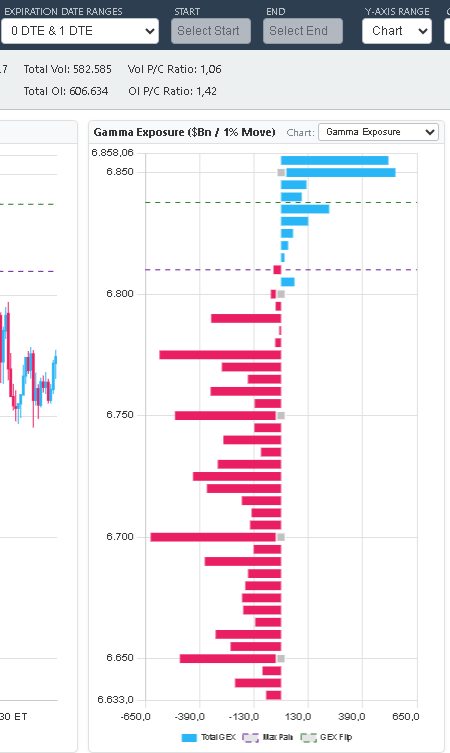
GEX Metrix 0DTE gamma exposure chart showing SPX same-day expiration gamma distribution across strikes

0DTE GEX in the GEX Metrix dashboard — expiration selector set to same-day only. The gamma distribution is typically more concentrated around current ATM strikes than weekly or monthly expirations, with bars changing shape significantly as the session progresses.

What to look for on 0DTE expiration days:

  • The Zero Gamma Level for 0DTE-only GEX often sits closer to the current price than for multi-day expirations — meaning the market may be operating near a regime boundary
  • High OI strikes for 0DTE tend to cluster within a tight range of ATM (typically ±1–2%) — this is where pin risk is highest near close
  • When 0DTE GEX and multi-day GEX agree on a key level, that level is structurally stronger — multiple expiration horizons reinforcing the same strike
  • If 0DTE GEX is deeply negative overall, the market has limited gamma cushion for the day — trend continuation probability is higher than normal
Three Common Misconceptions About 0DTE and Gamma Risk

Misconception 1: "0DTE always amplifies moves"

Not always. On days where the majority of 0DTE positioning is slightly out-of-the-money on both sides (puts below, calls above, both OTM), net 0DTE GEX can be positive and dealers act as a stabilizing force — just like multi-day positive gamma. The amplification effect is most pronounced when one side of the market dominates, or when price moves through a cluster of strikes and forces rapid sequential hedges.

Misconception 2: "0DTE is only for retail gamblers"

The data does not support this narrative. Institutional flows — including hedging from large equity portfolios, volatility desks managing gamma exposure, and market makers themselves — represent a substantial fraction of 0DTE volume. 0DTE SPX specifically, as a cash-settled instrument, is heavily used by professional desks for same-day tail risk hedging, not just speculative bets.

Misconception 3: "You should avoid trading on 0DTE days"

Given that every SPX trading day now has at least one 0DTE expiration, avoiding those days would mean not trading SPX at all. The correct response is not avoidance but awareness — specifically, knowing where the 0DTE gamma is concentrated before each session, whether it is stabilizing or amplifying, and what the key intraday levels are. Traders who use GEX data treat 0DTE expiration days as higher-information sessions, not higher-risk ones.

The practical framework:

Check 0DTE GEX at open. Is it positive (dealers stabilize) or negative (dealers amplify)? What strike is the Zero Gamma Level for today's expiration? That single data point — available on the dashboard before 9:30 AM — tells you whether to expect a contained session or an environment prone to acceleration near key levels.
Frequently Asked Questions
Does 0DTE GEX change throughout the day?
Yes, significantly — and this makes 0DTE fundamentally different from multi-day GEX. As the session progresses, ATM strikes change as the underlying moves, time value decays rapidly, and new 0DTE positions are opened and closed. The GEX chart for same-day expiration can look materially different at 10 AM, 1 PM, and 3:30 PM. Platforms that update GEX data intraday (including GEX Metrix, which captures 15-minute snapshots) let you track how the 0DTE gamma picture is shifting through the session.
How do monthly expirations differ from daily 0DTE in terms of gamma risk?
Monthly expirations (third Friday of each month) carry much larger aggregate OI built up over weeks, which means the gamma concentration is larger in absolute terms. The single-day gamma at a monthly OpEx is typically several times larger than a typical daily 0DTE session. Quarterly expirations — where index futures, equity options, and index options all expire simultaneously — create the most extreme gamma events, with some estimates putting quarterly OpEx GEX at 3× the typical monthly figure. For more on OpEx mechanics, see the OpEx Effects article →
What is "pin risk" and when does it matter most?
Pin risk is the tendency of the underlying to gravitate toward a high-OI strike as expiration approaches, because dealers who are long and short gamma at that strike are both motivated to keep the underlying near it. For options buyers, pin risk means their position oscillates near worthless as the underlying tracks the strike. For directional traders, pin risk is useful: if a very large 0DTE strike cluster sits at 5,700, there is a gravitational pull toward that level in the final hour of trading. Conversely, if price breaks decisively through that cluster, the dealers who were stabilizing it must rapidly reverse their hedges — sometimes creating a sharp, momentum-driven move away from the pin level.
Continue Learning

Understanding 0DTE gamma risk sets the foundation for OpEx analysis and market structure mechanics. The next articles in this series cover how monthly and quarterly expirations amplify this effect, and how market makers manage the delta hedging that creates the structural levels you see on a GEX chart.

OpEx Effects Reference → What is GEX? → Live SPX GEX Dashboard →