OPEX Effects: Monthly & Quarterly Expirations

Quarterly expirations generate roughly 3× the structural impact of a typical monthly OPEX. Learn the week-before, expiration-day, and post-OPEX dynamics — with concrete patterns traders can plan around in advance

See Live GEX & OPEX Levels →
The Expiration Hierarchy — Not All OPEX Events Are Equal

Options expiration events occur on a calendar hierarchy, from daily to quarterly. Each level carries progressively more open interest — because higher-level expirations accumulate OI built up over weeks or months rather than just days. The amount of dealer gamma that must be unwound at each expiration scales accordingly.

At the bottom are daily (0DTE) expirations — active every session, generating real structural effects but within the context of a single day's positioning. Above that are weekly expirations (Friday SPX/SPXW), monthly expirations (third Friday of each month, where the heaviest institutional OI concentrates), and quarterly expirations — the "triple witching" or "quadruple witching" dates where index options, index futures, equity options, and equity futures all expire simultaneously on the third Friday of March, June, September, and December.

The data suggests quarterly OPEX generates roughly three times the structural market impact of a typical non-quarterly monthly OPEX. This is not because more traders participate on those days — it is because months of accumulated OI must settle simultaneously, forcing the largest dealer gamma unwind of the cycle.

Relative GEX impact by expiration type:

Daily (0DTE)
1× baseline
Weekly Friday
1.3–1.8×
Monthly (3rd Fri)
2–3×
Quarterly (Triple)
5–8×

Approximate relative GEX magnitude — actual values vary by market conditions and positioning cycle.
Key dates for the 2025–2026 calendar: Triple witching falls on the 3rd Friday of March, June, September, and December. Quarterly effects begin building in the week before — mark these dates at the start of each quarter as structural planning anchors.
The Three Phases of Every Major OPEX Event

Each monthly and quarterly expiration follows a recognizable three-phase structure. Understanding which phase you are in changes how you should interpret GEX signals during expiration week.

1
The Week Before — Hedging Buildup and Positive Gamma Compression
In the 5–7 trading days before a major expiration, institutional participants who will hold positions into expiry have already settled their positioning. The result is a typically high-positive-gamma environment: large blocks of near-ATM OI are present, dealers are net long gamma, and the market tends toward compression and mean-reversion. This is why the "week before OPEX" is historically associated with low realized volatility and range-bound behavior — the gamma cushion is near its maximum. Fade extremes, sell breakouts, and target the range midpoints defined by the current Call Wall and Put Wall.
2
Expiration Day — Gamma Concentration, Pin Risk, and Final Unwind
On the expiration day itself, gamma becomes extremely concentrated near ATM strikes as time value collapses. The first phase of the day (9:30–11:00) can see sharp moves as 0DTE-type gamma dynamics apply to the monthly/quarterly OI — any large move at open forces rapid dealer re-hedging. The final two hours (2:00–4:00 PM) are the high-risk window: positions approaching expiration trigger binary win/lose outcomes, pin risk at major strikes is highest, and dealers must fully unwind their delta hedges by close. The last 30 minutes before expiry on a quarterly date is one of the highest-volume, most structurally driven sessions of the year.
3
Post-OPEX — The Gamma Reset and Volatility Regime Change
The Monday (or first session) after a major OPEX is qualitatively different from any session during the buildup phase. A large block of OI has just expired. Dealers have fully unwound their hedges. The new GEX picture is determined entirely by the remaining forward OI — next month's and next quarter's positioning — which is typically much smaller in dollar terms than what just expired. The immediate post-OPEX period is often characterized by lower positive GEX or even a negative gamma regime, making moves more directional and less contained than during the pre-OPEX compression phase. This is one of the most reliable regime shifts in the annual calendar.
4
The Rebuild — New OI Accumulates Over the Following Weeks
Over the 2–4 weeks following a major expiry, institutional participants roll their hedges into the next cycle: buying next-month protection, selling covered calls, building structured product positions. This OI accumulation gradually restores positive gamma to the market and compresses volatility back toward the low-vol pre-OPEX state. This cycle repeats every month, with the quarterly version running at higher amplitude. Understanding where you are in this cycle — early rebuild (low GEX, higher vol tendency), mid-cycle (building GEX, moderate), or pre-OPEX (high GEX, compressed vol) — is one of the most durable frameworks for multi-week market structure analysis.
Quarterly OPEX — Why Triple Witching Is Different in Degree, Not Just Kind

Triple witching (index options + index futures + equity options expiring simultaneously) occurs four times per year. The structural impact is larger than monthly OPEX not because of a different mechanism but because of scale: three months of OI instead of one month, futures rolls adding an additional mechanical layer, and institutional rebalancing that often coincides with quarter-end window dressing.

The week before a quarterly OPEX often exhibits the most sustained positive-gamma compression of the quarter — SPX realized volatility in this window has historically run below the trailing 30-day average more consistently than any other comparable period. Conversely, the immediate post-quarterly OPEX period — the first full week of the new quarter — is one of the highest-volatility windows of the calendar, as the gamma structure resets at its lowest annual level.

  • Quarterly OPEX weeks: historically compressed SPX realized vol (positive gamma maximum)
  • Post-quarterly week 1: historically elevated realized vol (gamma reset minimum)
  • Futures roll (typically Tues–Thurs before expiry): can create temporarily dislocated GEX readings — be aware of which expiration month drives the dominant OI
  • Quarter-end portfolio rebalancing adds an independent flow layer on top of the options dynamics — but GEX structural levels remain valid guides for the dealer hedging component
Planning framework for quarterly OPEX:

Mark the quarterly OPEX date. The week before: high positive gamma → range trade, sell extremes. The day of: watch for large post-open move, then close-hour pin dynamics. The week after: expect lower GEX, widen stops, favor momentum over mean-reversion until OI rebuilds.
Using Historical GEX Data to See OPEX Cycles
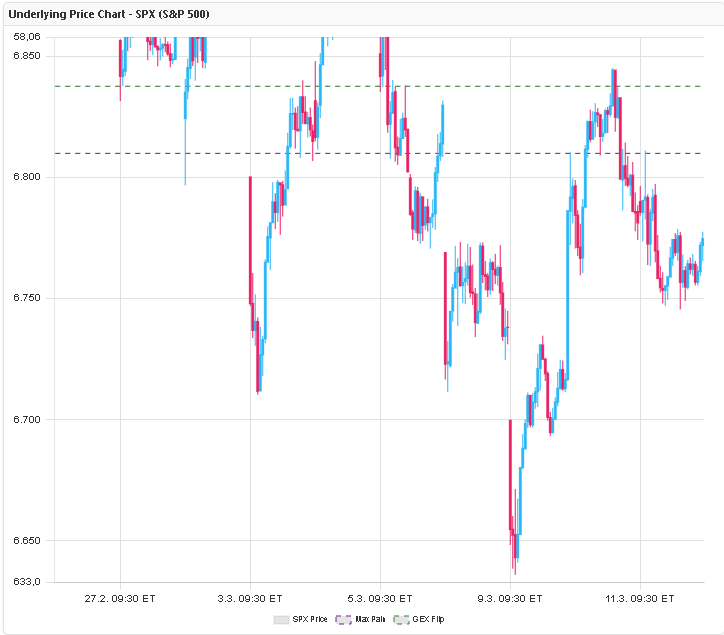
GEX Metrix price chart with gamma exposure history overlay showing structural levels across OPEX cycle

Price chart with GEX history in GEX Metrix — shows how gamma exposure levels shift through the OPEX cycle. The buildup of positive GEX in the pre-OPEX period and the reset after expiration are visible as a recurring structural pattern in the dashboard's historical snapshots.

What to check on the dashboard in OPEX week:

  • Compare current GEX levels to the same week last month — is positive GEX meaningfully higher than the cycle average? That confirms pre-OPEX compression
  • Watch the Zero Gamma Level vs current price — if price is firmly above it during expiration week, range-trading bias is supported by the structure
  • Check GEX the Monday after expiry — if it has dropped significantly, post-OPEX volatility expansion is more likely
  • On expiration day: note the highest-OI ATM strike — that is the pin target for the final hour
Frequently Asked Questions
Is the "week before OPEX is calm" pattern still reliable?
It remains statistically supported but is not a guarantee. The pattern rests on positive gamma compression from large near-ATM OI — which is typically present before major expirations. However, when a macro catalyst (unexpected economic data, geopolitical event, Fed surprise) hits during the pre-OPEX window, the structural positive gamma can be overwhelmed by the fundamental flow. In those cases, GEX levels still act as reference points, but the compression behavior breaks down as dealers must re-hedge aggressively regardless of the underlying structural state. The pattern is a base rate, not a certainty.
What is the difference between monthly OPEX and the "third Friday effect"?
They are the same event. Monthly options expiration in the US falls on the third Friday of each month — this date is what traders commonly call "monthly OPEX" or the "third Friday effect." Non-quarterly monthly OPEX is driven primarily by equity options and standard index options. Quarterly OPEX (March, June, September, December) adds index futures expiration on top, creating the simultaneous "triple witching" that amplifies the structural dynamics described in this article.
Should I avoid trading during OPEX week?
No — OPEX weeks, particularly in the compression phase, are often among the most tradeable weeks of the month for certain strategies precisely because the GEX structure is most clearly defined. High positive gamma means structural levels are most reliable, and the range boundaries (Call Wall, Put Wall) act as high-confidence fade zones. What changes during OPEX week is which strategies are most appropriate: range-trading and selling-premium approaches tend to outperform momentum-following approaches during the buildup phase, and the reverse holds in the post-OPEX reset. Adapting to the phase rather than avoiding it is the more productive response.
Continue Learning

OPEX effects are the macro version of the same dealer gamma mechanics that operate every day. The final article in this series explains the mechanical process in detail: exactly how market makers manage delta hedging, and why this shows up as the structural levels you see on every GEX chart.

How Market Makers Hedge Delta → 0DTE Gamma Risk → Live GEX & OPEX Dashboard →