What is Gamma Exposure (GEX)?

A complete guide for SPX options traders — the formula, the two market regimes, key price levels, and how to build your pre-session routine around GEX data

See Live SPX GEX Levels →
What is Gamma Exposure (GEX)?

Gamma Exposure, or GEX, is a measure of the total gamma that options market makers — the dealers who take the other side of most options trades — carry across all active strikes and expirations. It tells you, in dollar terms, how much the collective delta of all dealer positions changes for every 1% move in the underlying price.

That definition matters because of what it forces dealers to do. Market makers do not speculate on direction — they sell options and then hedge the resulting delta exposure continuously to stay neutral. When GEX is large at a specific strike, even a small move toward that level requires dealers to execute large buy or sell orders in SPX, ES futures, or SPY to re-balance. This mechanical hedging is not discretionary. It happens on every tick.

The result is predictable, structural buying and selling pressure at levels that any trader can identify in advance — before the session opens.

The GEX Formula:

GEX per strike = Option Gamma
× Open Interest
× Contract Size (100)
× Spot Price²
× 0.01

Total GEX is the sum across all strikes. A positive total means dealers are net long gamma. A negative total means dealers are net short gamma. The sign determines which market regime you are in — and that changes how you should trade.

Why GEX Matters More Than Ever in Today's Market

US equity options volume has grown more than 150% over the past decade — while underlying stock volume grew only around 30% over the same period. That gap tells a clear story: options activity now dwarfs equity activity in relative terms, and the dealer hedging flows that result have become a primary driver of intraday price movement.

For SPX specifically, the numbers are staggering. On a major monthly expiration, the total delta notional expiring in SPX options alone can exceed $400 billion. That is not notional options premium — that is the directional exposure that must be unwound or rehedged by dealers as the day unfolds. No other single instrument generates this concentration of structured hedging flow.

The practical implication: understanding GEX is no longer an advanced technique reserved for options specialists. If you trade SPX, ES, NQ, or any US equity index product, you are already trading against dealer hedging flows every day — whether you track them or not.

  • Options volume has grown 5× faster than stock volume over the past decade
  • SPX options generate $400B+ in expiring delta on major quarterly expirations
  • 0DTE SPX options now represent over 40% of daily SPX volume
  • Dealer hedging flows are mechanical — they follow math, not sentiment
  • GEX levels are identifiable before the session opens
  • Works for directional traders — you do not need to trade options to use this data
Positive vs. Negative Gamma: Two Completely Different Markets

The sign of total GEX — positive or negative — is the single most important output of gamma exposure analysis. It defines the regime you are trading in, and the correct trading approach is nearly opposite between the two.

Positive Gamma Environment

Dealers are net long gamma — they bought calls or sold puts.
  • • Price drops → dealers must BUY the underlying to re-hedge → creates support
  • • Price rises → dealers must SELL the underlying to re-hedge → creates resistance
  • • Net effect: price is pulled back toward equilibrium after each move
  • • Market behavior: range-bound, compressed volatility, mean-reverting intraday
  • • Trading edge: fade extremes, sell breakouts that lack volume, target range midpoints

Negative Gamma Environment

Dealers are net short gamma — they sold calls or bought puts.
  • • Price drops → dealers must SELL the underlying to re-hedge → accelerates decline
  • • Price rises → dealers must BUY the underlying to re-hedge → accelerates rally
  • • Net effect: moves are amplified, not dampened, by dealer activity
  • • Market behavior: trending, volatile, momentum-driven intraday
  • • Trading edge: follow momentum, use wider stops, avoid fading strong moves
Key insight: The regime does not just affect volatility — it changes the probability distribution of outcomes for the day. Most experienced traders determine their entire directional bias before the open based on whether price is above or below the Zero Gamma Level.
How GEX Looks Across Strikes — A Simplified View

In a GEX bar chart, each horizontal bar represents the gamma exposure concentrated at that strike. Positive bars (green) mean dealers are long gamma there — stabilizing. Negative bars (red) mean dealers are short gamma — amplifying. The largest bars are your structural levels for the session.

5,800
+$4.2B
Call Wall — highest positive GEX. Dealers sell here as price approaches → strong resistance.
5,750
+$2.1B
Moderate positive GEX — mild support/resistance, not a key level on its own.
5,700
+$0.4B
Near Zero Gamma — transitional zone. Regime can flip here if enough put positioning builds.
5,650
−$1.9B
Negative GEX — dealers amplify moves here. Breakdowns accelerate below this level.
5,600
−$3.6B
Put Wall — highest negative GEX. Dealers buy here as price approaches → can create sharp bounces, but moves can accelerate further below.

Illustrative example — not real-time data. See live SPX GEX levels at gexmetrix.com/demo →

The 4 Key GEX Price Levels Every SPX Trader Should Know

These four structural levels emerge directly from the GEX calculation. They are not drawn by hand or based on price action history — they are derived from where dealer gamma is most concentrated right now.

⭕ Zero Gamma Level (Gamma Flip)

The price at which total dealer gamma crosses from positive to negative. Above this level, the market is in a stabilizing, range-bound regime. Below it, the market is in an amplifying, trending regime. This is the most important single level in GEX analysis. Before each session, knowing whether price opens above or below zero gamma determines the baseline probability for a range day vs. a trend day.

📈 Call Wall

The strike with the highest concentration of positive call gamma. As price approaches the Call Wall from below, dealers must continuously sell the underlying to stay delta-neutral — creating strong mechanical resistance. In a positive gamma environment, the Call Wall frequently marks the upper boundary of the intraday range and acts as a reliable fade level for experienced traders.

📉 Put Wall

The strike with the highest concentration of put gamma. As price drops toward the Put Wall, dealers must buy the underlying to hedge — which can create sharp, reactive bounces. However, if the Put Wall is below the Zero Gamma Level, dealer buying may slow a decline temporarily without stopping it. Understanding which side of zero gamma the Put Wall sits on changes how you trade a test of that level.

⚡ High Volatility Level (HVL)

A derived structural level that marks the threshold beyond which dealer hedging is projected to create accelerated directional movement. A confirmed break of the HVL is widely used by futures and SPX traders as a signal that price is entering a genuine trend day rather than a probe. It is particularly useful for confirming breakout setups that would otherwise look ambiguous on a price chart alone.

What a Real SPX GEX Chart Looks Like
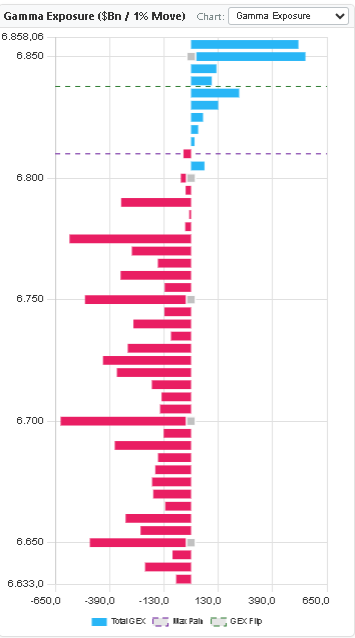
GEX Metrix SPX Gamma Exposure chart showing call gamma (blue) and put gamma (red) bars by strike in Split View

SPX GEX Split View. Blue bars = positive call gamma (stabilizing). Red bars = negative put gamma (amplifying). The tallest blue bar is the Call Wall — dealers sell there. The gray dashed line is the Zero Gamma Level.

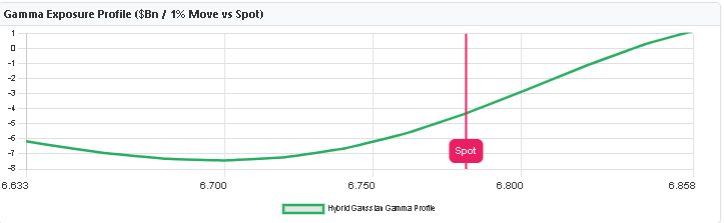
GEX Metrix Gamma Exposure Profile curve showing simulated gamma exposure across the full SPX price range

Gamma Exposure Profile — the green curve shows simulated total GEX across the full price range. Where the curve crosses zero is the Gamma Flip level. Values below the zero line indicate negative gamma — trend-amplifying conditions at that price.

A Note on the Open Interest Data Behind GEX

One question that comes up frequently: "GEX is calculated from yesterday's Open Interest — doesn't that make it stale by 10 AM?"

The short answer is no, for most sessions. Open Interest reflects the aggregate positioning of institutional options traders — the large funds, banks, and structured product desks that drive the majority of notional options volume. These positions do not flip intraday. Unless there is an unusually large catalyst that generates extraordinary volume relative to existing OI, yesterday's closing OI remains the dominant structural force for the day's dealer hedging.

The GEX levels you identify before the open — Call Wall, Zero Gamma, Put Wall — often continue to act as meaningful price magnets and barriers throughout the session, even as exact dollar figures drift slightly as new intraday positions accumulate.

Why this works in practice:

Think of overnight OI as the structural map of where institutional money is positioned. Intraday volume adds noise around that structure — but the underlying architecture rarely changes before close. The levels hold because the positions behind them hold.

The exception is high-volume catalyst days (Fed decisions, major earnings, surprise macro events) where intraday flows can materially shift the GEX picture. On those days, treat the levels as guides rather than hard lines, and use tighter confirmation rules before acting.

For a deeper look at how OI data is used in GEX calculations and how it differs from nominal volume, see Gamma Exposure (GEX) Explained →

Using GEX in Your Pre-Session Routine — A 3-Step Framework

The traders who get the most value from GEX data are not the ones who check it mid-session and react — they are the ones who use it before the open to build a scenario-based plan. Here is a simple three-step framework:

Step 1: Identify the Regime

Before anything else, note whether the current SPX price (or where ES futures are trading pre-open) sits above or below the Zero Gamma Level. This sets your baseline expectation: above = range day tendency, sell extremes. Below = trend day tendency, follow momentum. One data point, one clear bias.

Step 2: Mark the Structural Levels

Note the Call Wall, Put Wall, and HVL on your chart. These are your session's high-probability reaction zones. Plan specific entries, stop placements, and targets around them before the open. Knowing that 5,800 is the Call Wall means you already have a hypothesis about what happens if ES approaches that level — you are not guessing in the moment.

Step 3: Build Two Scenarios

Define one scenario for each regime: a range-day scenario (price bounces between Call Wall and Put Wall) and a breakout scenario (price breaks through HVL and the Zero Gamma Level turns negative). Having both planned in advance means your decision at the key moment is execution, not analysis. The scenario the market chooses will be clear within the first 30–60 minutes of the session.

Ready to apply this now?
Load the live SPX GEX data and run this three-step check before tomorrow's open.

Open the Live GEX Dashboard →
Frequently Asked Questions
Do I need to trade options to use GEX data?
No — and this is one of the most underappreciated edges in the market. GEX data describes what market makers are forced to do in the underlying (SPX, ES, SPY, NQ), not in the options market itself. If you trade ES futures, SPX, or any major index product, dealer hedging flows appear on your chart as structural support, resistance, and momentum zones regardless of whether you ever trade an options contract. Directional traders, scalpers, and swing traders all use GEX levels for the same purpose: knowing where large, mechanical buying and selling pressure is waiting before the session starts.
How often do GEX levels change?
The levels shift as new options positions are opened and old ones expire or are closed. On a typical day, the major structural levels (Call Wall, Put Wall, Zero Gamma) remain relatively stable because the underlying institutional OI that drives them changes slowly. However, after major expirations — particularly monthly and quarterly OpEx dates — the entire GEX picture can reset significantly as large blocks of OI expire and dealers unwind their hedges. This post-OpEx reset is one of the most common triggers for a regime change and a shift in volatility.
Is GEX the same as Open Interest?
No. Open Interest is simply the count of outstanding options contracts at each strike. GEX is a dollar-weighted measure that converts OI into the actual market impact of dealer hedging. Two strikes can have identical OI but very different GEX values depending on their gamma (which is highest near at-the-money options and near expiration) and the underlying price. GEX is the better measure for identifying price levels that matter because it tells you where dealer hedging flows are largest in absolute dollar terms — not just where the most contracts happen to be outstanding.
What is the difference between the Zero Gamma Level and Max Pain?
These are related but distinct concepts. Max Pain is the price at which the maximum number of options contracts expire worthless — it is a static level that is defined relative to expiration. The Zero Gamma Level is dynamic — it is the price at which total dealer gamma crosses from positive to negative based on current positioning, and it can shift throughout the week as positions change. The Zero Gamma Level is more useful for intraday and short-term trading because it directly describes the current hedging regime, not just where option writers would benefit most at expiration.
Continue Learning

Now that you understand what GEX is and how it creates structural levels, the next step is learning to read a live gamma chart in detail — how to identify levels quickly, what the bar heights and colors mean, and how to use historical snapshots to spot regime shifts.

GEX Reference Guide → 0DTE Options & Gamma Risk → Live SPX GEX Dashboard →