Where People Go Wrong on Day One
Almost everyone who opens a GEX chart for the first time does the same thing. They scan for the biggest bar, declare it "the level," and start planning trades around it. I did it too. The problem is that the biggest bar, on its own, tells you almost nothing.
Quick orientation before we start: strikes run up the vertical axis, gamma exposure in dollar billions runs across the horizontal. Green bars are net positive GEX at that strike (calls dominant), red bars are net negative (puts dominant). Simple enough. But a $2 billion call wall at 5,600 means something very different when spot is sitting at 5,580 versus 5,450. Same bar, completely different trade.
What matters is where price is relative to where dealers have to hedge, and that takes reading the chart in a particular order.
That order is what this guide covers. Five checks, maybe five minutes once you have done it a few times. By the end you will know which levels on the chart carry structural weight and which are just tall bars.
Start With Zero Gamma. Always.
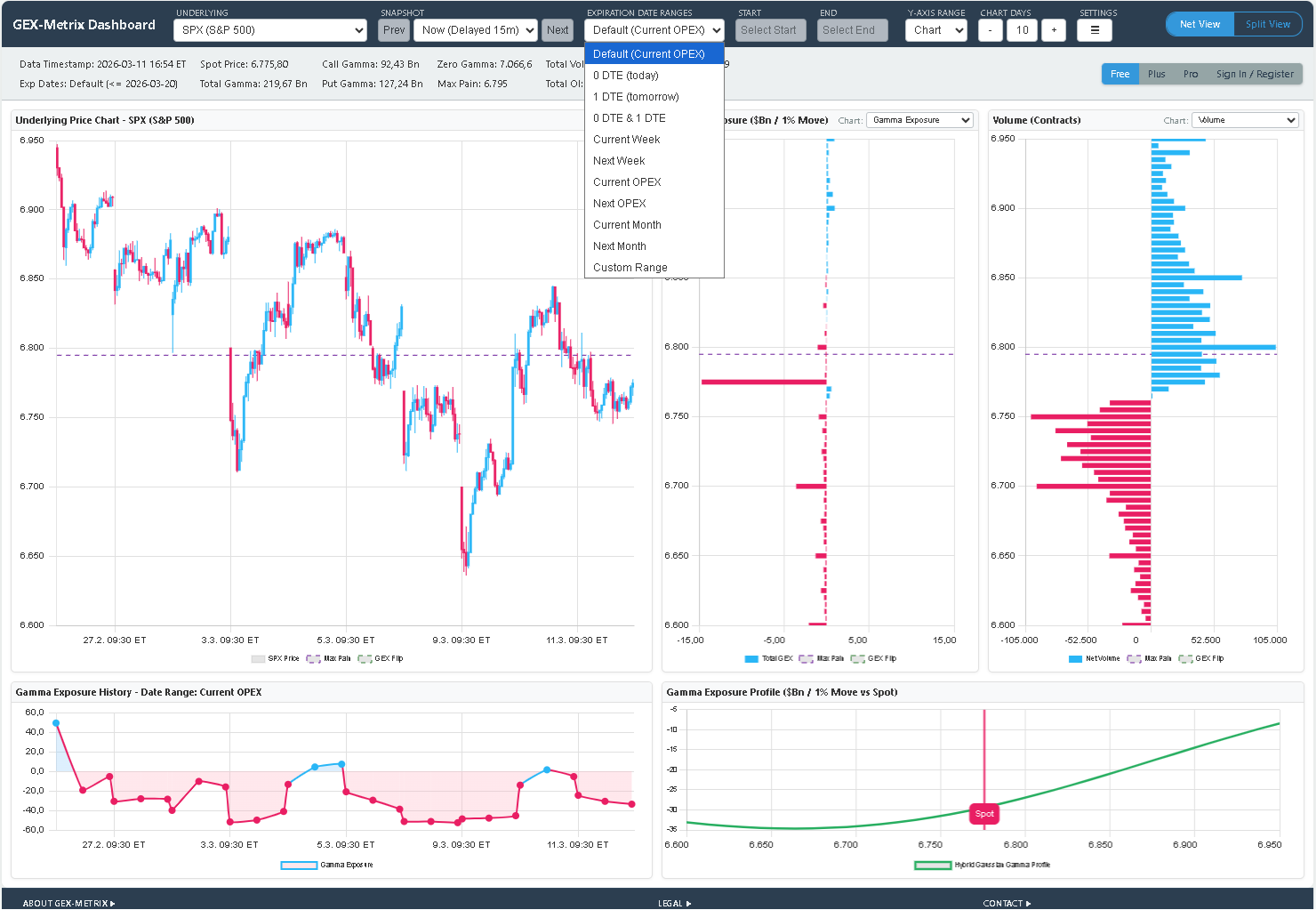
Before I look at a single wall or bar, I find the zero gamma level, the price where total dealer gamma exposure crosses from positive to negative. Some people call it the gamma flip. Do not picture it as one clean strike; in practice it is a transition zone between two very different market regimes.
Why does this come first? Because everything else on the chart reads differently depending on which side of the flip spot is on. Above it, dealers are net long gamma, so they buy dips and sell rips to stay hedged. That behavior dampens moves. Below it, they are net short gamma and hedge in the same direction as the move: selling into declines, buying into rallies. That amplifies. Same bars on the screen, opposite implications.
Spot Above Zero Gamma
- Dealers buy dips, sell rips.
- Price tends to revert to range and breakouts often fade.
- Usually a low realized vol environment.
Spot Below Zero Gamma
- Dealer hedging amplifies moves.
- Dips can accelerate, rallies can squeeze.
- Trending behavior gets more likely and realized vol picks up.
Spot At the Flip
- The regime itself is unstable, since small swings flip the sign of total gamma.
- Expect chop.
- In my experience this is the worst place to size up.
Is spot above or below zero gamma right now? If you can not answer that, you do not know whether you are in a range day or a trend day, and nothing else on the chart will save you. I check this before coffee.
The Two Walls
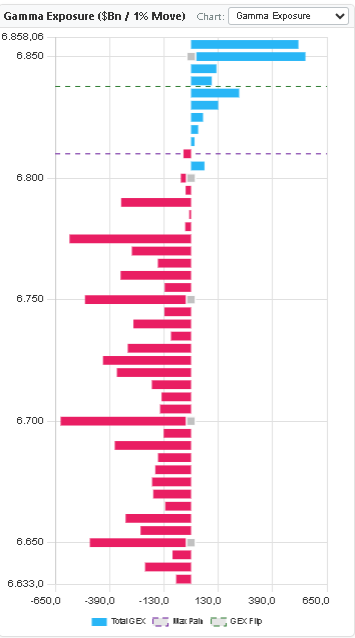
Once you know the regime, look for the two dominant structural levels. The Call Wall is the largest positive GEX bar above current price. The Put Wall is the largest negative GEX bar below it.
The Call Wall is where dealers hold their biggest long-gamma position from calls. As spot climbs toward it, they have to sell the underlying to stay hedged, and that selling shows up as resistance. It does not always hold (nothing always holds), but the pressure is real. Watch price approach a big Call Wall and you will often see it stall, retest, stall again before anything breaks through.
The Put Wall is where the misconceptions live. Dealers are short puts at that strike, which means that as spot falls toward it, they have to sell the underlying to keep their delta flat. So dealer hedging near the Put Wall accelerates the decline rather than cushioning it. Treat it as a zone where downside moves speed up, and plan accordingly.
Call Wall
Largest positive gamma concentration above spot. Dealers sell here to re-hedge, so price often stalls or reverses into it.
Put Wall
Largest negative gamma concentration below spot. Dealers sell as price falls through it, which speeds the decline up instead of slowing it down.
Treating the Put Wall as support because there is a huge pile of open interest sitting below price. Big put OI at a strike means dealers are short those puts, and short-put dealers sell more as spot falls. The mechanics point down, not up. I do not lean on the Put Wall as a floor, and I would suggest you do not either.
Net View, Split View, and When I Use Each
The chart has two main display modes, and mixing up what each one shows is probably the most common way people misread a level.
Net view collapses each strike into a single bar: calls minus puts. It is the fastest way to see which strikes carry the largest net dealer hedging obligation. My morning read is always net view first. Structure, walls, flip, done.
Split view pulls each strike apart into its call component and its put component. Now you can see what drives a level: call OI, put OI, or both stacked on top of each other. When a level looks big in net view and I am thinking about trading near it, I flip to split view to understand what is actually there. A ceiling, a floor, or just a churn zone?
Say net view shows roughly zero GEX at the 5,500 strike. Looks quiet. Then split view reveals a large call bar and a large put bar of nearly equal size sitting there. That strike is anything but quiet. Dealers are hedging in both directions around it, and in my experience those strikes produce volatility, not calm.
Net View
The morning read. Find the Call Wall, Put Wall, and Zero Gamma Level fast. Use it whenever you want a quick bias check.
Split View
The deep read. Tells you whether a level is call-driven, put-driven, or both. Worth the extra minute before you put on anything near a specific strike.
Profile View
Simulated GEX across the whole price range rather than per strike. Shows how exposure shifts as spot moves away from here. This is the one I use for range and breakout scenarios, covered in the next section.
The Profile Chart Answers the "What If" Question
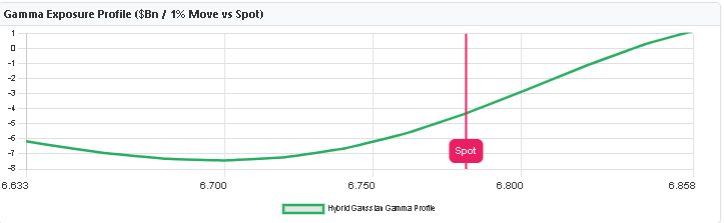
Everything so far describes exposure at today's price. But gamma is not fixed; it changes as spot moves away from each strike, so the bar chart you are staring at is only valid right where spot sits now. The gamma profile handles this by recomputing total GEX across the full price range. Instead of a snapshot at one price, you get a curve showing how exposure evolves for every spot scenario.
Concrete case: spot at 5,550, and the profile shows GEX turning sharply negative at 5,480. Now you know a move to 5,480 crosses the flip, and the regime changes right there. No guessing. The curve maps it out for you.
The profile is also where you catch local flip points, price levels where gamma crosses zero somewhere inside the range rather than at the aggregate flip. A local flip below current price means that even on a broadly positive gamma day, there is a specific downside zone that can go temporarily negative and accelerate any move that reaches it. Those zones are easy to miss on the bar chart and obvious on the profile.
Watch the Walls Move
A single GEX snapshot is a photograph. Useful, but it tells you nothing about direction of travel. The last check is comparing today's chart against earlier snapshots: 15, 30, or 60 minutes back intraday, or against yesterday's close for the overnight view.
What you are hunting for is net change in positioning at the levels you care about. If the Call Wall at 5,600 was $3.2B positive two hours ago and it is $2.1B now, that wall is eroding. Writers at that strike are covering or rolling. And an eroding Call Wall breaks a lot more easily than a stable one.
An eroding Call Wall breaks a lot more easily than a stable one.
The reverse read matters just as much. A Put Wall that keeps growing more negative while spot falls tells you fresh puts are being bought into the decline. Dealers are stacking short-gamma exposure at that level, their hedging obligation grows, and the move gets more fuel. That is a pattern worth respecting.
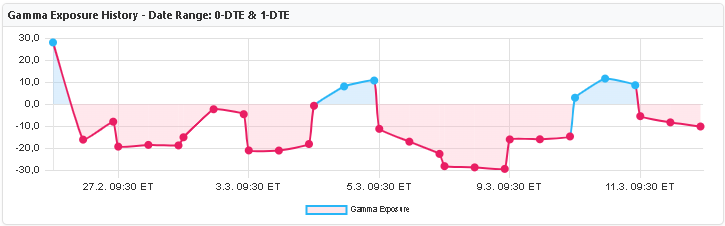
GEX shifts hardest around the 9:30 ET open, again around noon as OTM options decay, and into the close as 0DTE volume settles. A level that survives the open and carries through midday deserves more trust than one that only showed up at 9:15 from overnight positioning.
Putting It Together: A 5-Minute Pre-Session GEX Routine
This is how the five checks compress into an actual routine. Run it in net view first, then flip to split view for any level you plan to trade near. Once you have done it a few mornings it takes less than five minutes. It answers the three questions that matter before any session: what regime am I in, where are the structural ceilings and floors, and is positioning building or eroding at those levels?
Find the zero gamma level. Is spot above or below the flip?
Mark the Call Wall (largest positive bar above spot) and Put Wall (largest negative bar below).
Flip to split view for both walls. Call-heavy, put-heavy, or mixed?
Check the gamma profile for where total GEX crosses zero as spot moves away from here.
Compare against the prior session's close snapshot. Did the walls grow or shrink overnight?
Set your range: the zone between Put Wall and Call Wall is the day's expected trading range. Assume it holds until you see evidence of a regime flip.
That last step deserves a word, because the expected daily range (the distance between Put Wall and Call Wall) is probably the most underused output on the whole chart. Historically, spot has closed inside that range in roughly three out of four sessions. And when it does break out, the move often runs fast, because the hedging flow that kept price pinned near the middle simply vanishes.
That is the core tension in reading any GEX chart. Within-range days are high probability but small; breakout days are rare but big. The profile chart shows you where the gamma density thins out, and those thin zones are where breakouts get room to run.
If you take one habit away from this page, make it the ordering.
Zero gamma first, every time, because the regime decides how everything else reads.
Then the walls, remembering that the Call Wall carries mechanical selling pressure while the Put Wall offers no cushion at all. Net view for orientation, split view before you commit money near a strike. The profile for where the regime would change if price moves. And the snapshot history for whether the walls you are leaning on are getting stronger or quietly hollowing out.
Practice on a Live Chart
The fastest way to get comfortable with any of this is to stare at a live chart while the market is open. The free demo shows live SPX gamma exposure (zero gamma level, Call Wall, Put Wall, and profile), refreshed every 15 minutes. No sign-up required for the free demo.
Open the Free GEX Chart What is GEX?