Somebody Took the Other Side of Your Trade
When you buy an SPX call, you rarely trade against another retail account. A dealer takes the other side, almost every time. Banks, prop firms, specialized options desks: the firms that quote two-sided markets all day and get called market makers or dealers (the two labels are interchangeable).
Here is the part people get wrong. A dealer does not want your trade to lose so theirs wins. The desk earns the bid-ask spread across millions of transactions, and to keep that spread it runs the book delta-neutral: positioned so a small move in the underlying (up or down) leaves the aggregate P&L roughly flat. Directional risk is something they pay to get rid of, constantly.
And staying flat takes work. Every time the underlying moves, every option in the book changes its delta (the rate at which the option's value changes with the underlying). So the dealer buys or sells SPX, SPY, or ES futures to offset the drift. That adjustment is delta hedging.
One desk doing it is noise. Every desk doing it all day, on the largest options complex in the world, moves the market.
The dealer's position mirrors the trader's:
| Trader buys… | Dealer is short… | Dealer's delta exposure |
|---|---|---|
| Call option | Short call | Negative delta (short the underlying) |
| Put option | Short put | Positive delta (long the underlying) |
| Call option | Short call | To hedge: dealer buys underlying |
| Put option | Short put | To hedge: dealer sells underlying |
Dealers do not consult a market outlook before hedging. Risk frameworks, capital rules, and internal limits force the flatten. The flows are algorithmic, and they fire whenever price drifts far enough to push the book's delta past its tolerance band. Predictable inputs, predictable output.
One Trade, Followed All the Way Through
Abstractions hide the mechanics, so follow a single institutional trade from the order ticket to the hedge and back.
A fund buys 2,000 SPX calls
Strike 5,800, three weeks out, with SPX trading at 5,720. That is about 1.4% out of the money, and the option carries a delta of roughly 0.32: each $1 move in SPX moves this option about $0.32.
The dealer sells them and does the math immediately
Short 2,000 calls, 100 shares of notional per contract. Net delta: −0.32 × 2,000 × 100 × $5,720, roughly −$366 million. Left unhedged, a 1% SPX rally costs the desk about $3.7M. Nobody sits on that.
Buy $366M of the underlying
ES futures, SPX exposure, or a mix. Within minutes of the options print, the book is flat again: small moves in SPX now produce offsetting gains and losses. This buying is the "dealer flow" traders talk about, and notice it carries no opinion about where SPX is going.
Then SPX moves, and the hedge is stale
Next day SPX rallies from 5,720 to 5,755, up 0.6%. The call is closer to the money now, so its delta has grown from 0.32 to about 0.38. The short delta is bigger too: −0.38 × 2,000 × 100 × $5,755 comes to −$437M. The dealer buys another ~$71M of SPX exposure to get flat again.
That re-hedge feeds the rally it is reacting to
One desk adding $71M of demand will not move SPX on its own. Multiply it across thousands of similar positions in the book and dealer buying into a rally becomes a measurable tailwind. In my experience this is most of the answer when the tape "moves like it wants to go higher" on a quiet day after some initial catalyst. Short-gamma dealer hedging amplifies the move that triggered it.
And on the way back down, the same machine sells
SPX slips from 5,755 back to 5,720, delta falls back toward 0.32, and suddenly the dealer holds more long exposure than the book needs. They sell the excess into the decline. That is the whole mean-reversion mechanism, no narrative required.
Rallies get chased, pullbacks get sold, and price keeps gravitating back to wherever delta was last balanced.
Thousands of These Hedges, Added Up, Are What GEX Measures
That was one trade. A real dealer book holds positions across thousands of strikes and expirations at once, and the total hedging requirement is just the sum. GEX is that sum, expressed in dollars per strike.
Where dealers carry a lot of gamma (usually concentrated near the money), delta changes fastest as price moves, so the re-hedging per point of movement is largest there. Those strikes show up as the tall bars on a GEX chart: the Call Wall, the Put Wall, the concentration points traders anchor to. And the bars come straight from the hedging obligation, with price action playing no part in drawing them.
The Zero Gamma Level is where the summed dealer gamma crosses from positive to negative. Above it, dealers sell rallies and buy dips, which dampens moves. Below it, the same machinery buys rallies and sells dips, which amplifies them. One line on the chart, and it tells you which way the biggest systematic flow in the market leans today.
2. Dealer takes the other side
3. Dealer nets out its delta
4. Dealer buys/sells underlying to flatten
5. Underlying moves, deltas shift
6. Dealer re-hedges, again and again
7. At scale: structural flow at key strikes
8. GEX = the dollar size of that flow
A hedge does not evaporate at the close. The institutional call position that forced $366M of delta hedging on Monday still demands roughly the same hedge Tuesday, because the open interest has not changed. So GEX levels built from prior-day OI carry forward as valid structural anchors until the position is closed out or expires.
The obligation persists; the levels persist with it.
Delta Also Moves When Price Does Not: Vanna and Charm
Gamma hedging is the biggest and most visible flow, but price is only one of the things that shifts a dealer's delta. Volatility shifts it (vanna). So does the calendar (charm). Dealers hedge both, and both leave fingerprints.
Vanna, delta's sensitivity to volatility (∂Δ/∂σ)
When implied vol changes, every delta in the book changes, even with the underlying frozen in place. Take a dealer sitting on a pile of OTM calls. If IV rises, those strikes become more plausible landing spots and their deltas climb, so the dealer has to buy more underlying to stay flat. That is why VIX spikes, macro catalyst days, and vol-crush sessions come with their own hedging flow. I wrote up the mechanics in the Vanna & Charm guide if you want the full treatment.
Charm, delta's sensitivity to time (∂Δ/∂t)
Let the clock run and OTM options quietly lose their chance of finishing in the money. Call deltas bleed toward zero; deep ITM put deltas settle toward −1. Price can sit perfectly still all week and the dealer's hedge still goes stale, so it gets unwound bit by bit. This is why dealer flow can show a steady buy or sell lean on calm days heading into expiration. Nothing happened. Time passed, and that was enough.
Two Questions I Get About This
Do market makers actually hedge continuously, or at set intervals?
Threshold-based, mostly. Risk systems watch the book's aggregate delta against tolerance bands, and when the drift exceeds the band (say the desk finds itself long or short more than $X million of delta) a hedge order fires. On a big SPX book that can mean hedging every few minutes in an active session and far less often when things are quiet. In the last hour before a major expiration (with gamma huge and price moving) the thresholds get hit almost constantly, so "continuous" becomes a fair description in practice. And can a desk simply skip the hedge? At a major institution, effectively no. Risk limits, regulatory capital rules, and internal mandates make carrying large naked delta a non-starter. That non-discretion is exactly what makes the flows worth mapping.
If dealers stay delta-neutral, how can GEX levels say anything directional?
The book is neutral at any snapshot in time, sure. But the direction of the next adjustment after a price move is anything but neutral. In positive gamma, SPX up means dealers sell and SPX down means dealers buy: a steady counter-directional flow that caps moves and shows up as the structural support and resistance on the GEX chart. Flip to negative gamma and the machine reverses, buying into rallies and selling into declines, adding fuel either way. The levels carry directional information because the mechanical response to price is predictably with-trend or against-trend depending on the sign of the gamma, even though no dealer anywhere is expressing a view.
April 15: Watching a Hedge Complete in Real Time
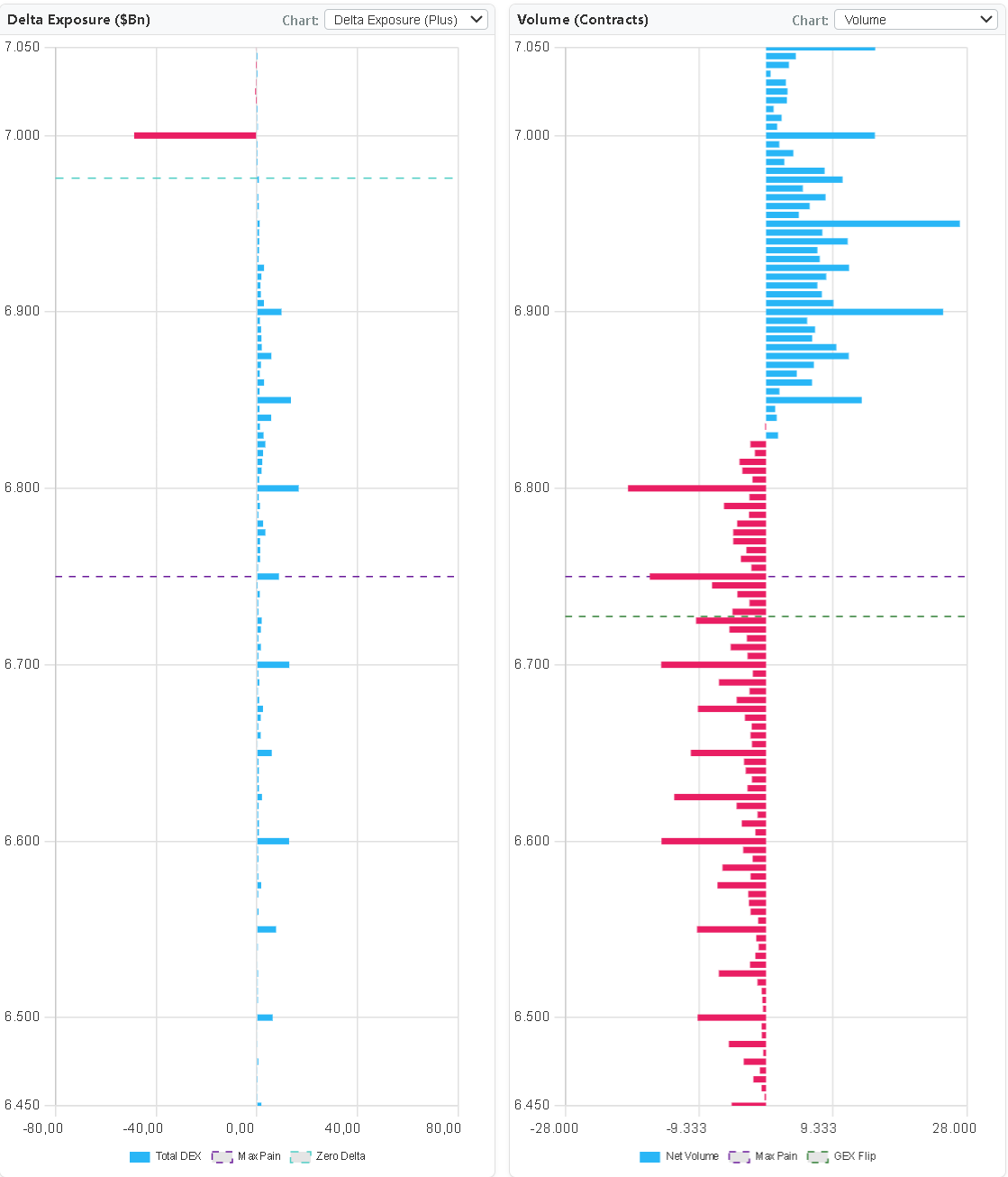
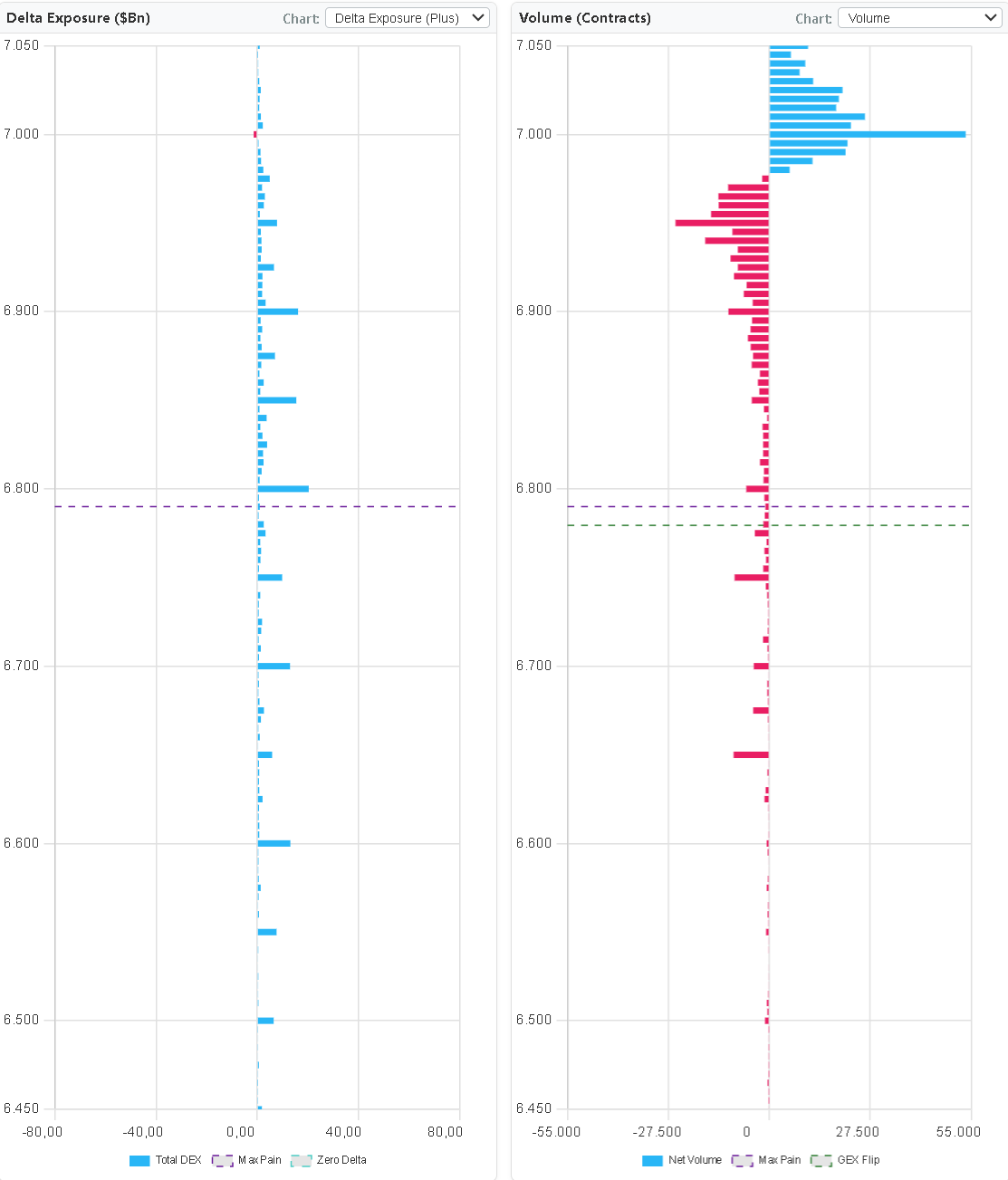
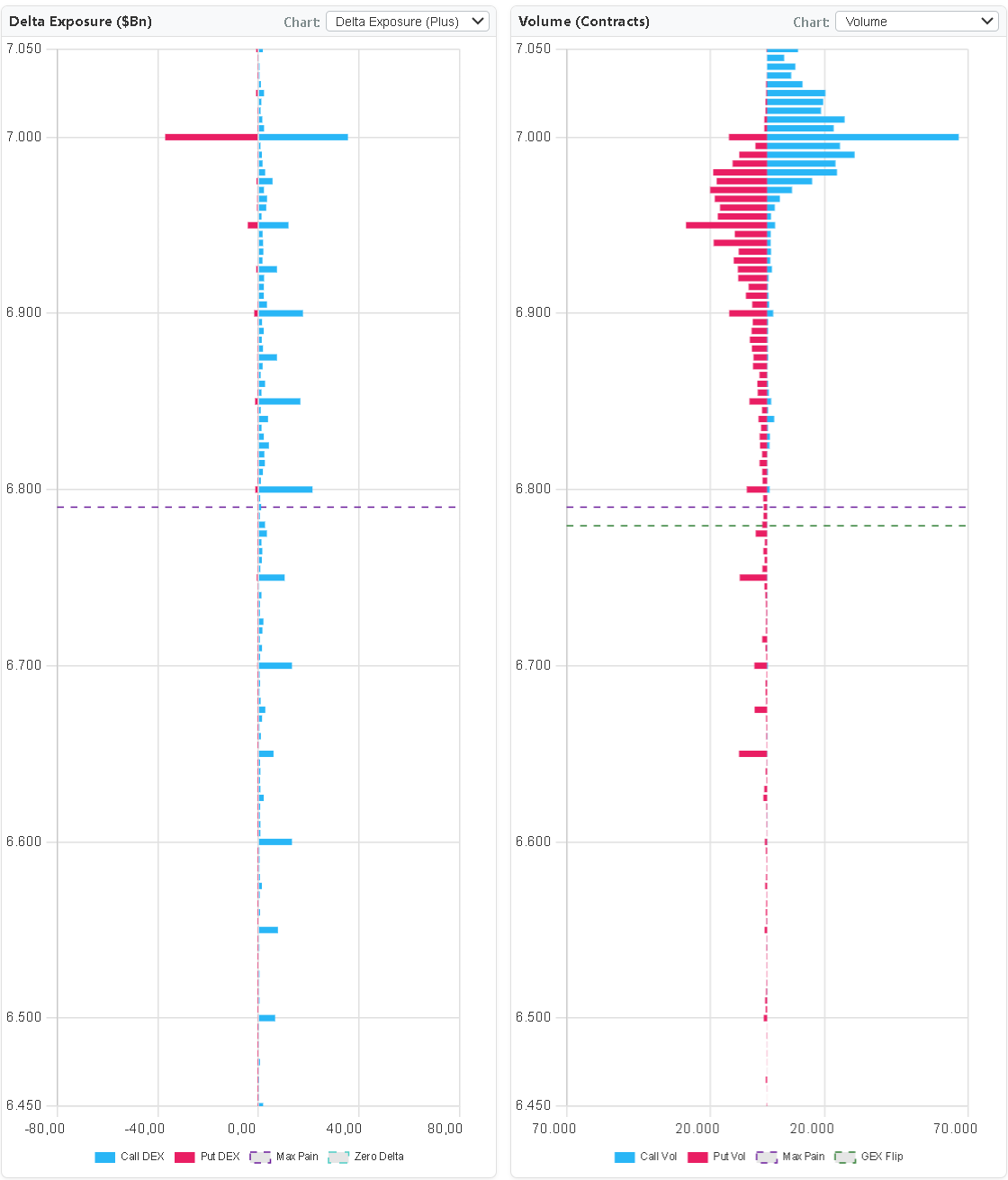
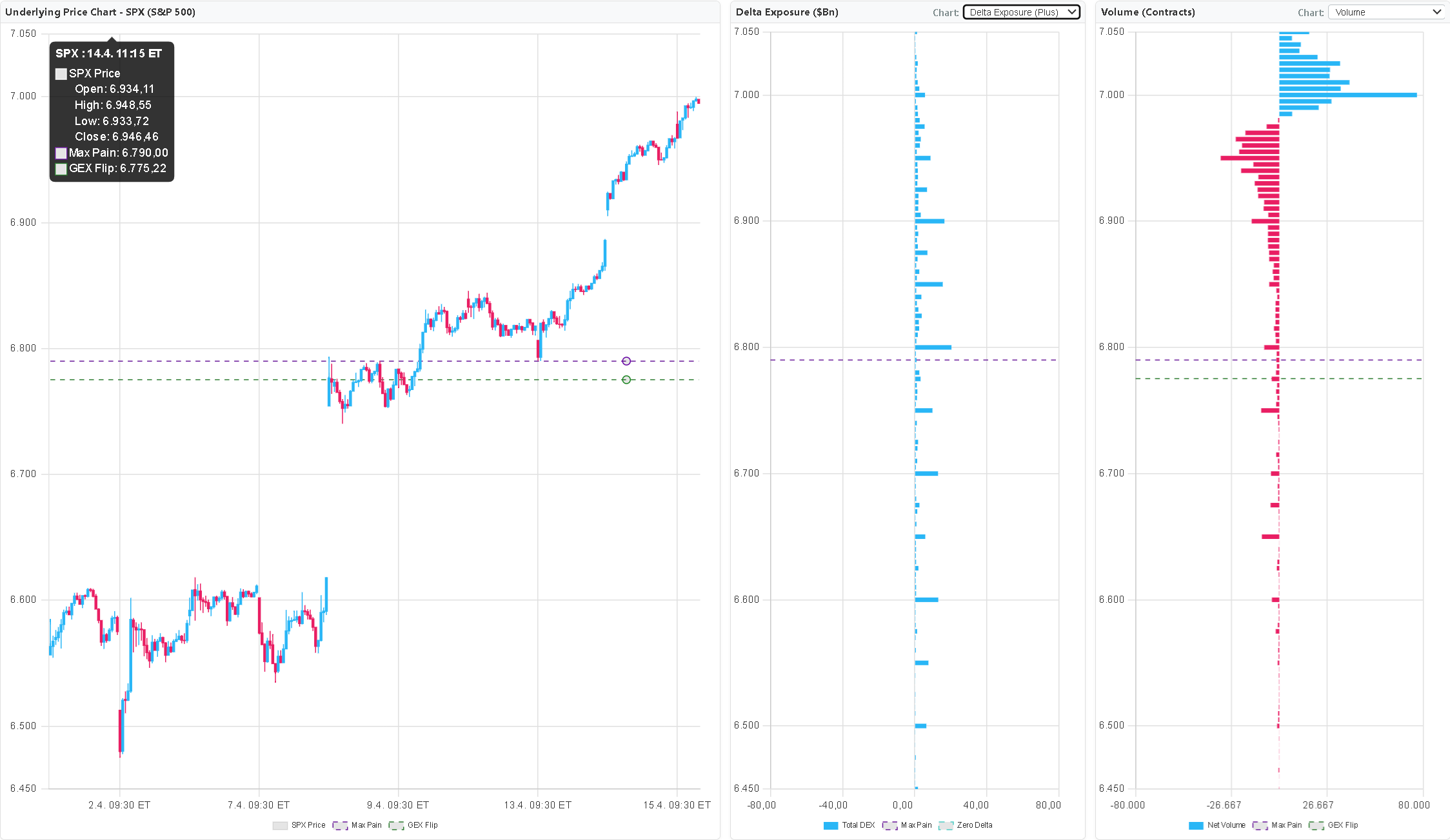
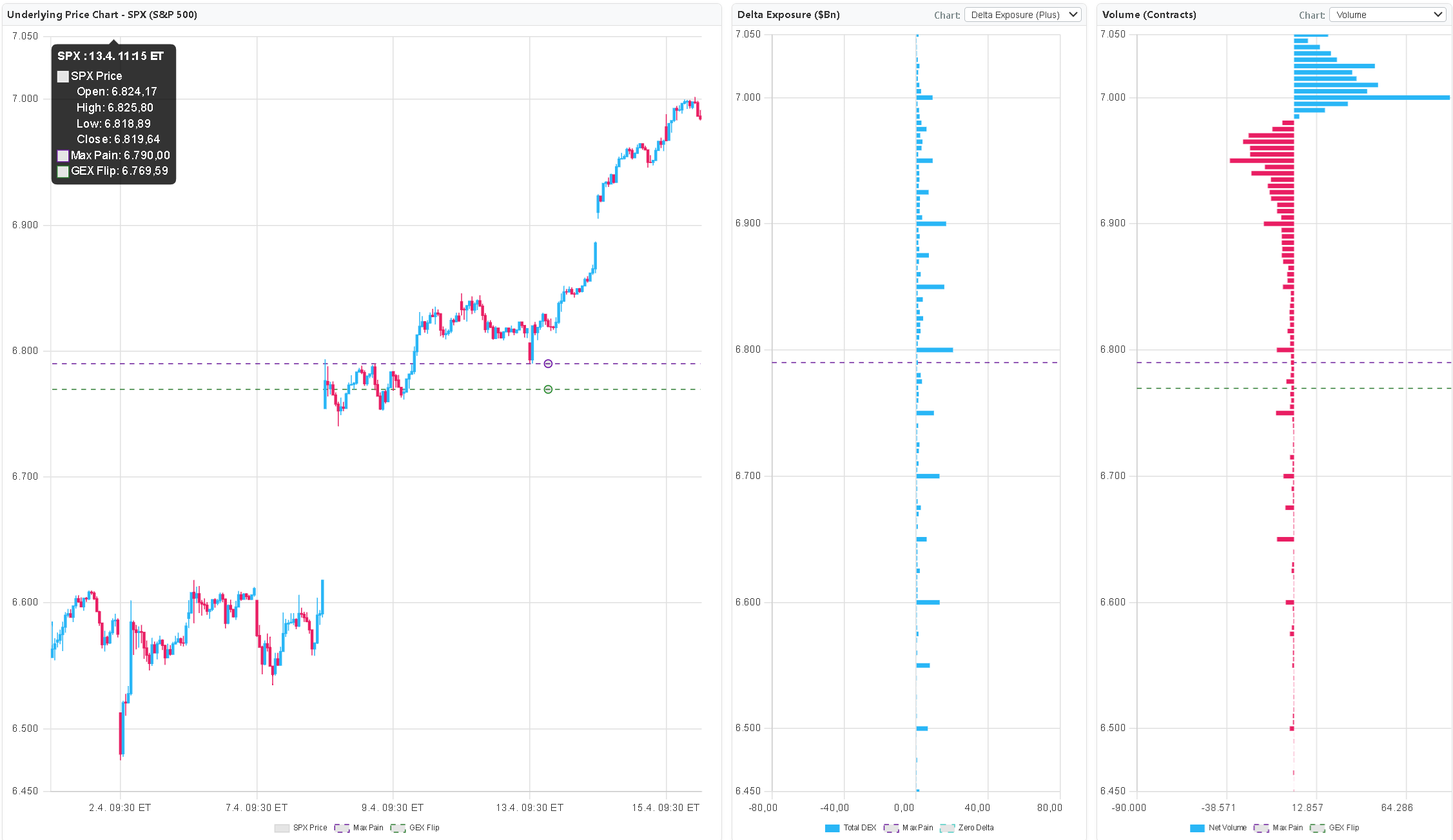
Everything above (the re-hedging loop, the delta piling up at a big strike, the moment the hedge finishes and the bid vanishes) played out on our own SPX charts on April 15, 2026. I kept the snapshots.
A large position, a fast rally, and a delta flip that marked the intraday high
April 15 was VIX options expiration day, two sessions before monthly OPEX. SPX came in carrying a large accumulated negative delta at the 7,000 strike, a position that had been building for weeks and most likely reflected market maker or serious institutional activity. SPX opened well below 7,000. Then it rallied hard.
Through the entire up move, the massive red bar at 7,000 stayed on the chart. Dealers kept buying the underlying to hedge their short-put exposure as price rose, and that mechanical buying was the rally. The negative delta at 7,000 stayed enormous all morning.
The buying that drove the rally was dealer delta hedging, and once the hedge completed and the net position flipped, that bid was simply gone. Price followed. The chart showed the whole sequence live, from the initial pile of negative delta, through its steady absorption, to the flip that called the top.
Where This Leaves You
Strip away the jargon and dealer hedging is a loop you can now trace by hand: order in, delta out, hedge, drift, re-hedge. GEX just adds the loop up across the whole book and puts a dollar figure on each strike. Once you have seen a hedge complete in real time, like the 7,000 flip above, the levels stop being lines someone drew and start being obligations someone holds. If you want to watch the same thing on today's book, the data is on the dashboard.
Watch the Same Mechanics on Today's Book
Load the live SPX data, switch to the Delta view, and see where the hedging obligations sit right now. The core view is free.
Open the Free GEX Dashboard Vanna & Charm Guide